

Art After the Abyss
Sieg Maandag survived the Holocaust as a child and processed the past through his paintings.
Sieg Maandag spent decades painting brightly colored canvases and ceramics, yet the picture he remains most well-known for is a black and white photograph that was taken of him in 1945 when he was seven years old. In the snapshot Maandag walks down a dirt road that emerges from a grove of trees, wearing a collared shirt, a sweater, and shorts, and looking like any young boy enjoying a day outside. But his gaze is pointedly directed to his right, averting his eyes from the endless piles of emaciated corpses that line the road beside him. This scene was captured by George Rodger, a photographer for Life magazine who accompanied the British 11th Armoured Division during the liberation of Bergen Belsen—the concentration camp in northern Germany where Maandag had been imprisoned for over a year. When the striking photo was published in the magazine in May 1945, it became a defining image of the liberation of the concentration camps.
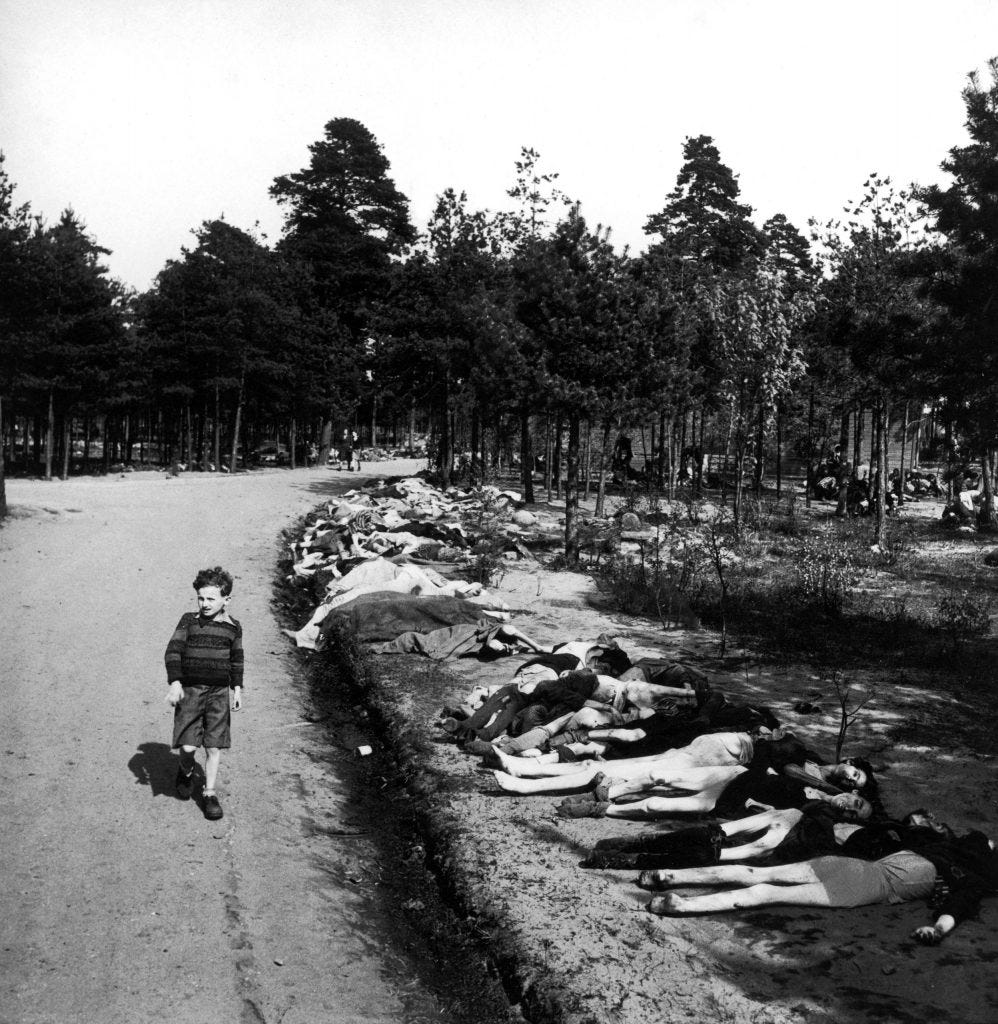
Maandag was born to a Jewish family in Amsterdam in 1937. When the Nazis invaded the Netherlands in May 1940, Maandag’s father was initially able to protect his family since he worked as a diamond merchant; the Germans required his expertise since they planned to start dealing in diamonds themselves. By 1943, however, the family was sent to Westerbork, a transit camp in the Netherlands, where they would remain for almost a year.
Many of the Dutch Jews who ended up in Westerbork were deported directly to Auschwitz, where the majority were killed upon arrival (over 100,000 Dutch Jews were killed during the Holocaust, a number that equates to about 75% of the Jewish population of the Netherlands before the Nazi invasion). Maandag’s family escaped the fate of immediate death in the gas chambers because members of the diamond trade were sent instead to Bergen Belsen, where the Germans hoped to start manufacturing diamonds. The Maandags arrived there in early 1944 and initially were allowed to live together in barracks. By the end of the year Maandag’s father was deported to Sachsenhausen, where he later perished, and his mother was sent to a slave labor camp near Neuengamme. Maandag and his younger sister were left alone in Bergen Belsen with fifty other Dutch children, miraculously surviving for five months until the concentration camp was liberated.
It was Rodger’s photograph in Life that reunited Maandag and his sister with their mother. His mother had been told that her children had not survived the war, but her brother in the United States recognized his nephew in the magazine. Though the children recuperated relatively quickly and started school, their experiences in Bergen Belsen never left them—for months after liberation Maandag slept with his shoes under his pillow, afraid they would be stolen. After finishing school he attempted a career in the diamond trade, but he did not enjoy it. After a failed pursuit at tailoring, he found himself restless and unhappy and soon decided to take off and travel the world. He ventured from Afghanistan to India and then to Bali, making many stops along the way; it was during his travels that he discovered painting and the contentment it brought to him.
In Sieg Maandag: Life and art in the aftermath of Bergen-Belsen, a book about the artist’s life written by his wife and Dawn Skorczewski, the artist is quoted as remarking, “As I got closer to finding myself and who I really was, I began to paint.” Yet when confronted with the diversity of his output, it is hard to believe that he ever truly found himself. When viewing the oeuvre of an artist (even an artist who was self taught like Maandag), it is usually easy to see the path they followed. Maandag’s paintings, however, do not follow any sort of thematic or technical trajectory. He appears to have begun with painting figural compositions, then moved toward abstraction, but then returned to more classical figures, punctuated with still lifes and some landscapes throughout the decades. While some of his paintings were true to life and charming, others were surrealist and grotesque.
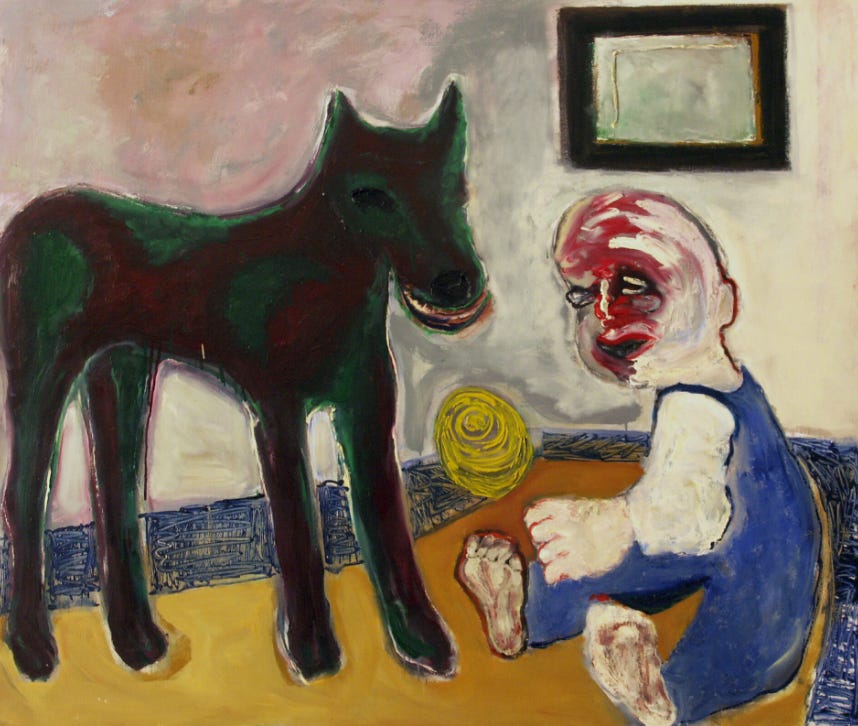
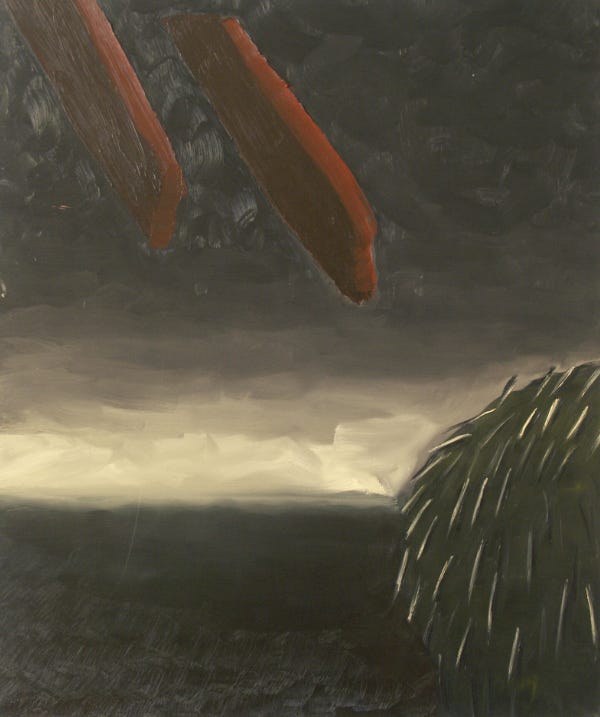
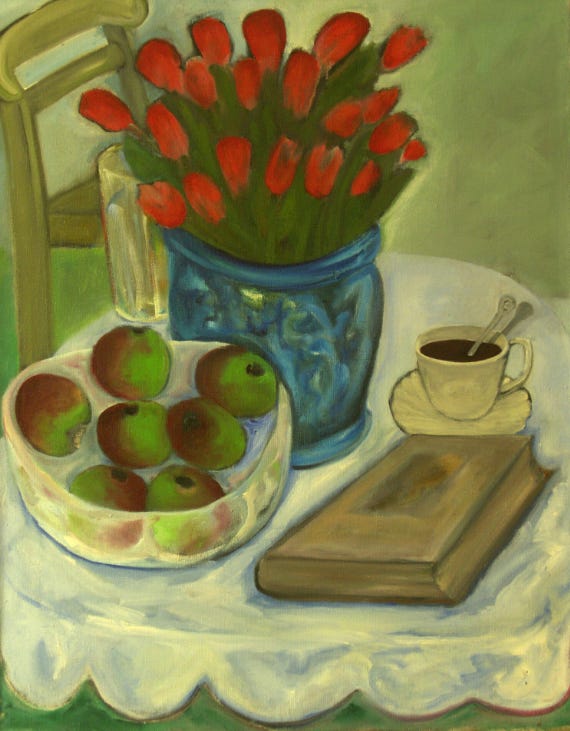
Maandag remarked in an interview with the Dutch newspaper Telegraaf in 1995, “I live in a world where war is still the order of the day, people are tortured, and children misused,” so the monstrousness and macabre-ism evidenced in his art is not surprising. And yet, it remains jarring. A painting titled Child’s Game (1999) depicts a child in blue overalls playing with a dog and a yellow ball. The dog is painted in shadows, and its teeth are bared in a gruesome smile, while the child’s face is depicted in a jarring whorl of red and black pigment. Though they seem to be an endearing pair from afar, upon closer inspection the same red pigment that mars the child’s face also lines the dog’s open mouth. Aggression (1983) is similarly nightmarish, but in its abstraction. The canvas is painted with a grey void interrupted only by a pair of oblong red shapes descending from the top of the scene, and a dark pile on the side that appears as if it could be a haystack. But is it a stack of hay, a pile of bodies, or a mound of barbed wire? Painted in between these dark and harrowing images, and in stark contrast to them, stands Still Life with Flowers (1989), a simple and pretty picture that depicts a bouquet of red tulips on a table covered with a scalloped white cloth, surrounded by a bowl of fruit, a delicate porcelain cup filled with coffee, and a book.
The one constant throughout Maandag’s practice were his portraits. They ran the gamut from beautiful and serene to frightening and monstrous. Maandag is quoted as observing, “There isn’t anything else to paint but faces. I see them as a reflection of my own face. Perhaps the search for faces among the crowd is a search for my original face. My authentic face, my face as a boy.” It may be that his obsession with figures was a search for the life he never had, a search for a childhood destroyed by the war that he could never recover. He could visualize this alternative reality through his art; it is easy to imagine that the charming scenes he painted were ideas of what his life could have been, and the violent images he put on canvas were the memories of the life he was forced to endure and from which he could not escape.
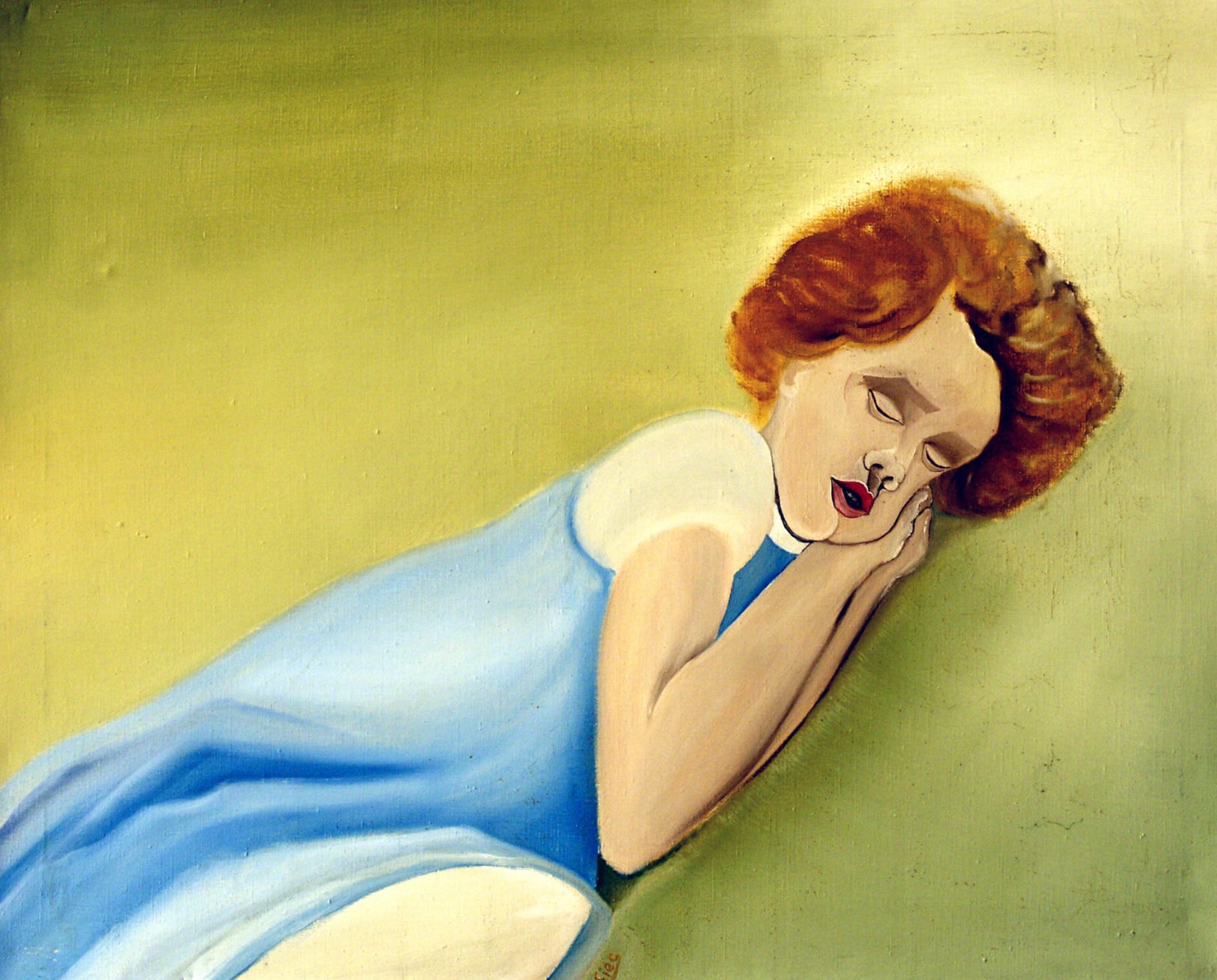
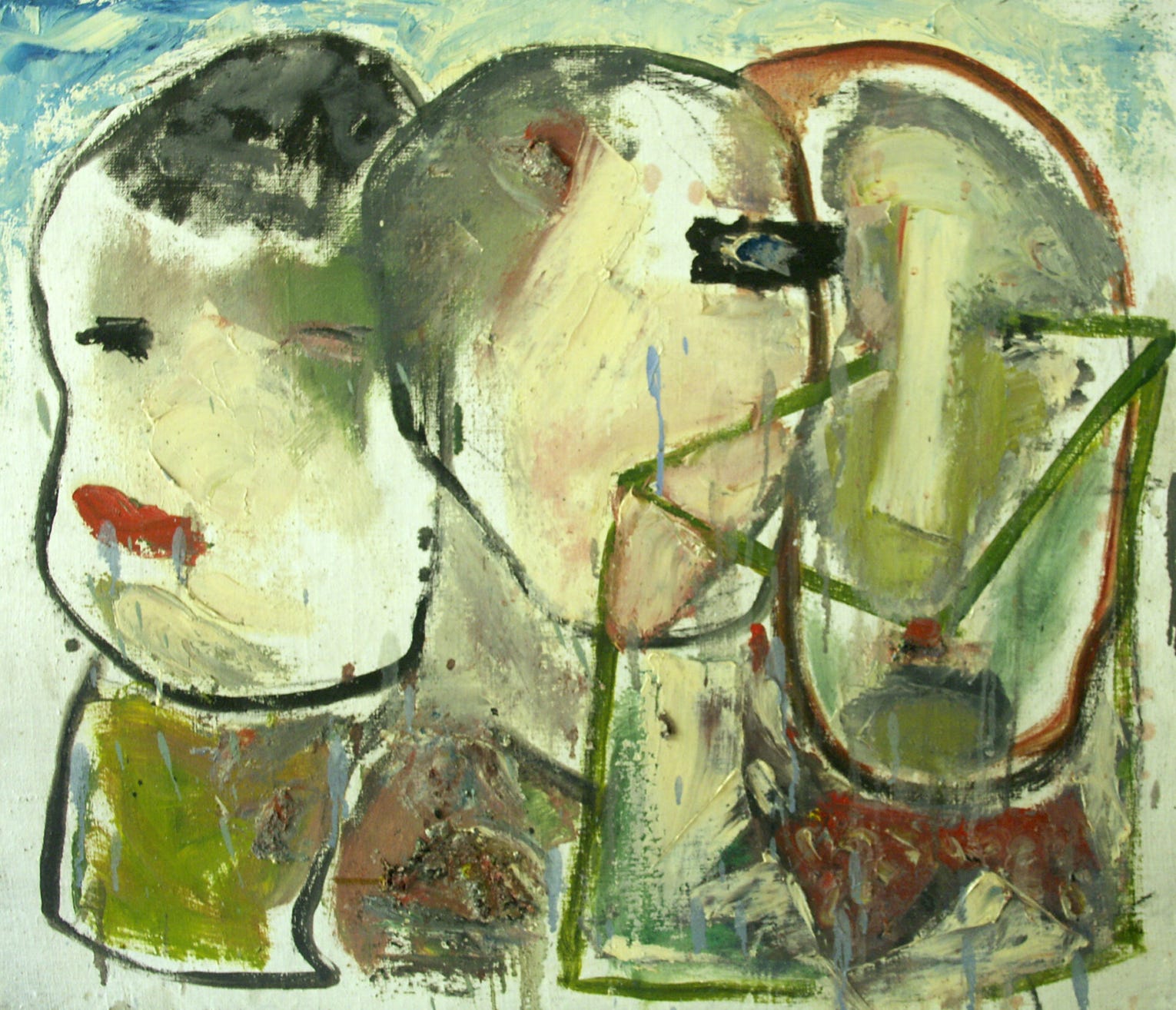
It is this lack of continuity and categorization in his works that makes Maandag so hard to decipher as an artist, and also what has made him the subject of many papers written by Holocaust historians and psychologists but not by art historians. In 2023, a volume of American Imago, a leading scholarly journal on psychoanalysis founded in 1939 by Sigmund Freud, was dedicated to Maandag’s work. In it the historian Dan Stone wrote, “there are two forms of art that government-sponsored museums and memorials feel to be ‘safe’ in representing the Holocaust: pure abstraction or direct, realist representation.” Maandag does not fit neatly in either category, and Stone surmises that the varying nature of Maandag’s paintings and the way they veered from abstract to surreal but were never entirely realist was “an unconscious recognition of his inability to name and hypothesize about his experience of the Holocaust.”
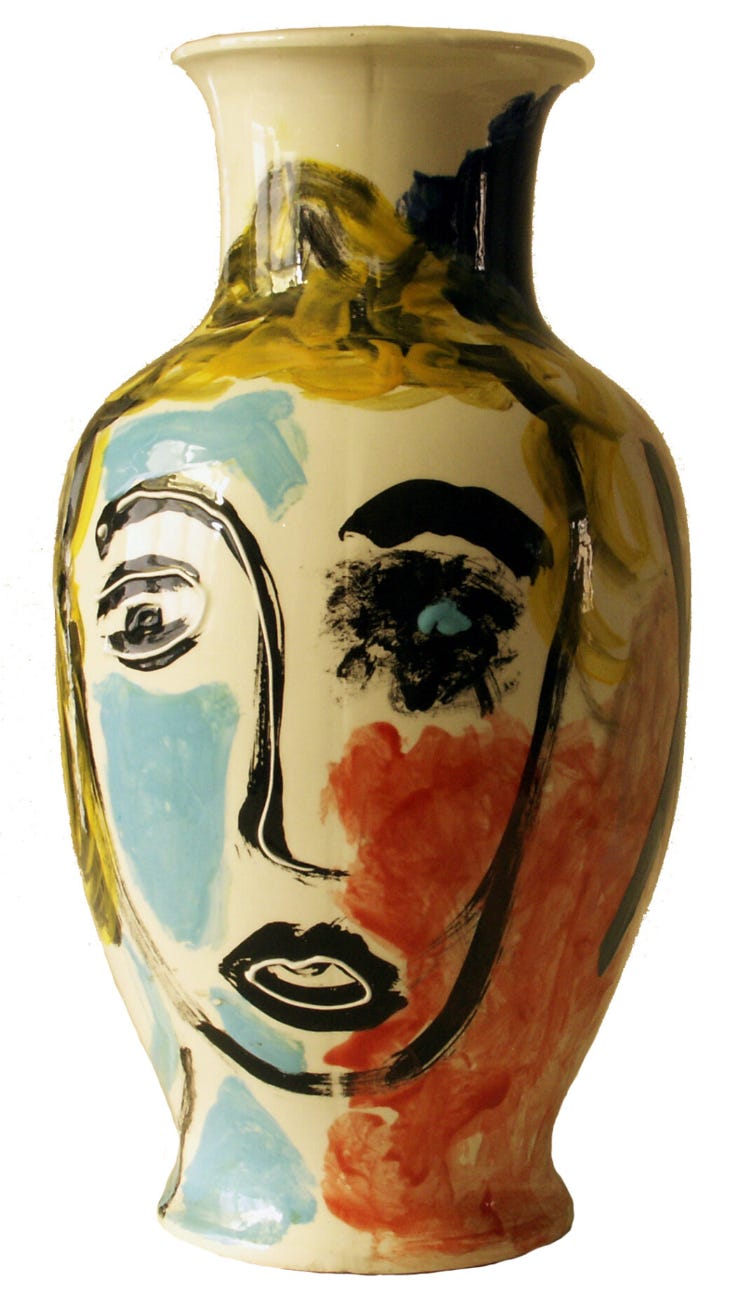
Towards the end of his career, Maandag turned to ceramics, decorating plates and vases with washes of brightly colored pigments and stylized faces that possessed a whimsiness and gaiety not found in his paintings. Perhaps by turning away from the art form he seemingly used for decades as a mechanism to grapple with his stolen childhood and memories of unimaginable horror, he could finally create art that was free from turmoil.
—Emily Selter
Thank you, Ms.Selter. I hadn't known of Maandag or his painting, but your essay was very informative and thoughtful. I hope to get to see his work in person some day.