

When Art Becomes a Weapon
Arthur Szyk’s war against Fascism at the Museum of Jewish Heritage.
On December 7th, the 84th anniversary of the United States’ entry into World War II, the Museum of Jewish Heritage in New York opened the exhibition Art of Freedom: The Life and Work of Arthur Szyk, which details the life and work of one of the most ardent Jewish propagandists of the war. Through his art, he ruthlessly ridiculed Nazi leaders and fought to save the lives of Jewish people across Europe.
Szyk was born in 1894 in Łódź, Poland, which was then part of the Russian Empire. His family sent him to study art at the Académie Julian in Paris, but at the outbreak of World War I he was conscripted into the Soviet Army and served on the German front. When the Polish-Soviet war began in 1919, Szyk quickly joined the fight for his homeland’s independence against the Bolsheviks, serving as the artistic director of the Department of Propaganda for the Polish army until the conflict ended in 1921.
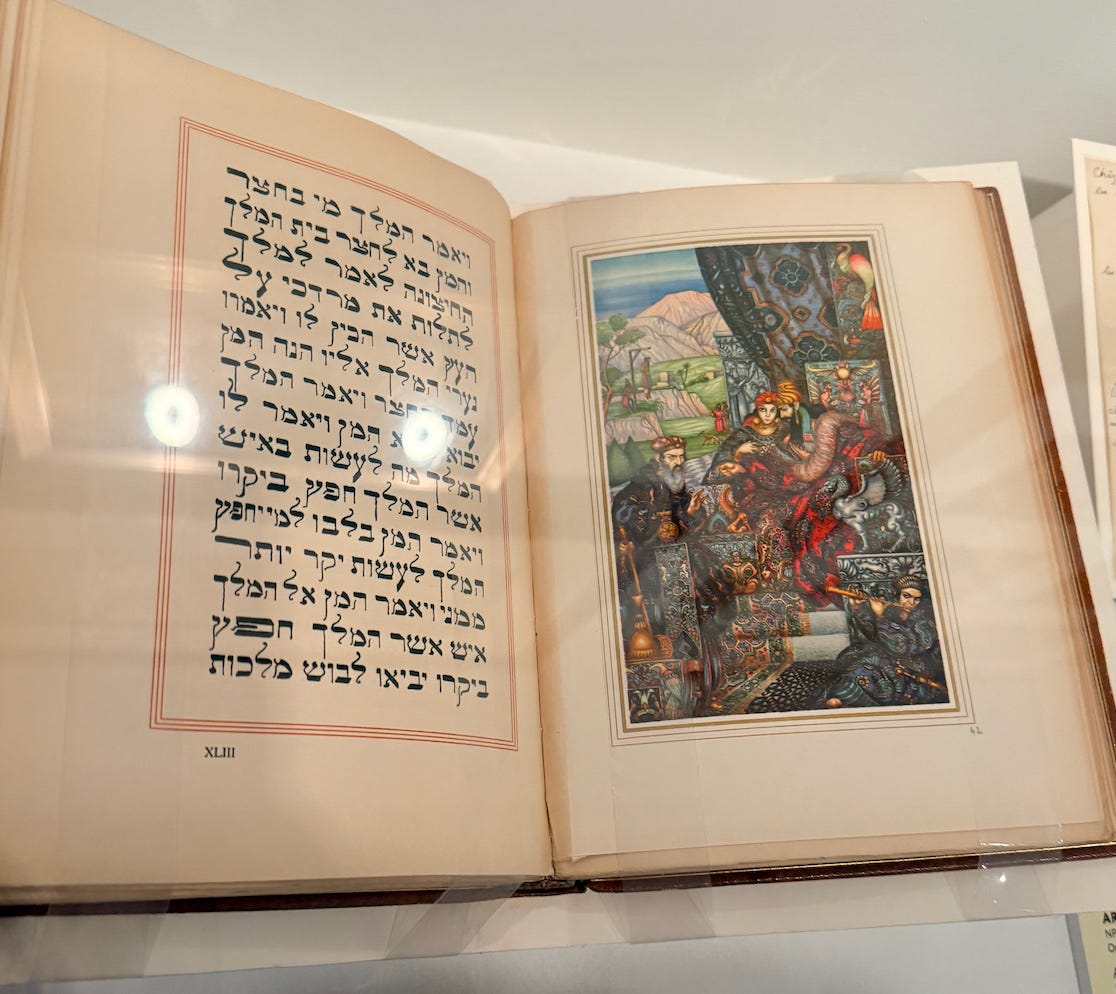
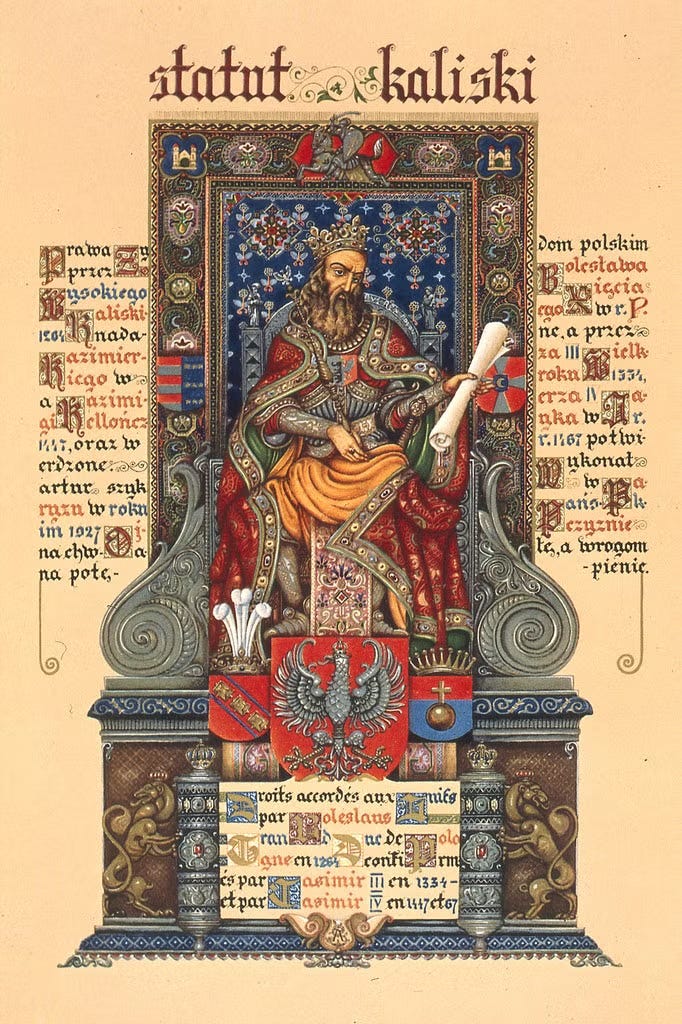
When Szyk returned to working on his own projects, his focus turned to the Jewish people of Poland, who faced pogroms and violence perpetrated by both the Poles and the Soviets. His first masterpiece was the Livre d’Esther, which illustrated the story of the Jewish heroine and was completed in 1925. His pictures recall Persian miniatures in their details and ornateness—only the faces and hands of the figures are visible; their bodies are cloaked in piles of richly colored fabrics decorated with oriental prints, and they sit in rooms draped with embellished curtains punctuated with Assyrian-inspired reliefs and monuments. But his next project, The Statute of Kalisz (1926-1930), relied on an entirely different history and culture: that of medieval Europe. The Statute was a medieval law issued in 1264 by a Polish duke that guaranteed rights for Jews in his domains, and Szyk’s illustrations accompanying the Statute were inspired by medieval-European illuminated manuscripts. The pictures were done in a simple palette of primary colors and highlight the architecture and landscapes of medieval Poland. His deftness at switching between cultures is impressive, and divulges both a rich knowledge of art history and an innate mastery of the technicality of drawing.
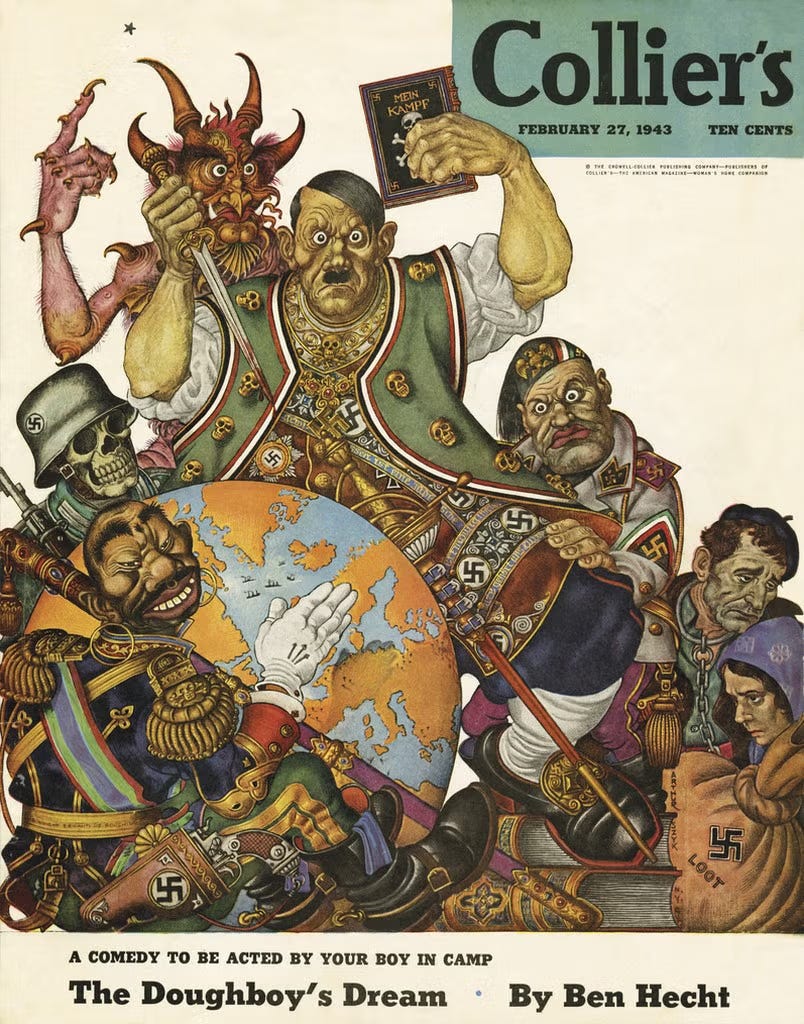
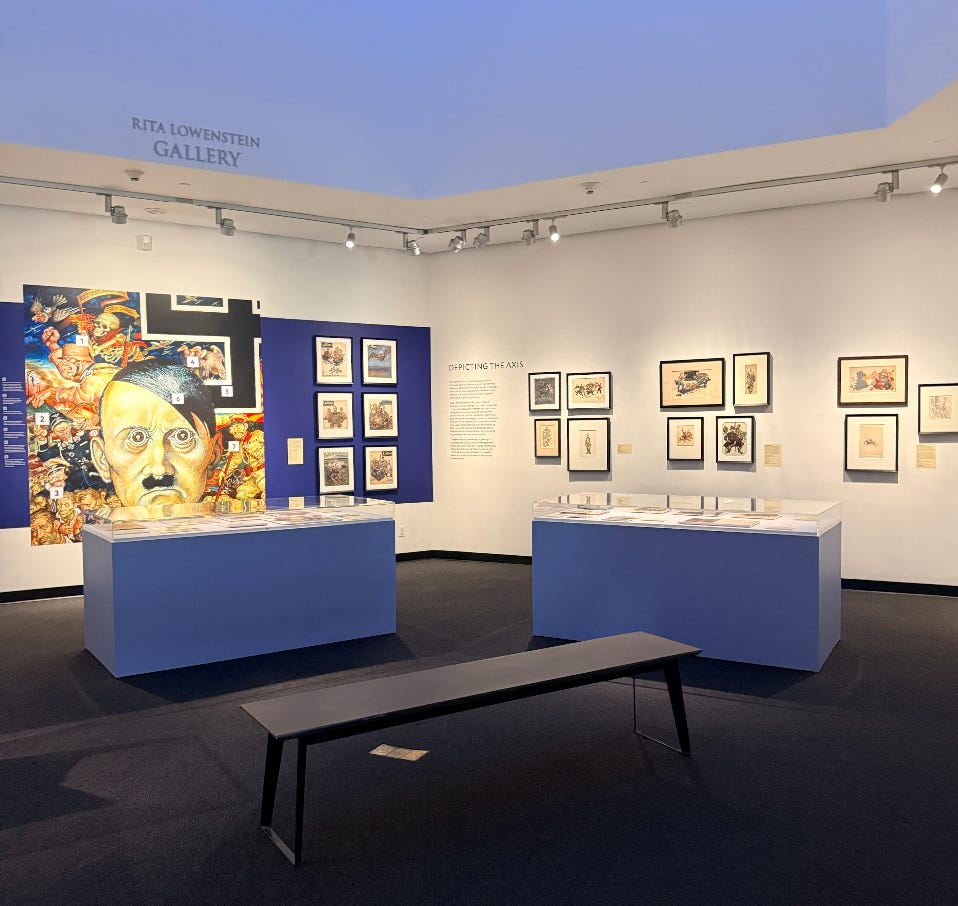
Where Szyk gained notoriety, however, was in his wartime propaganda drawings—and the museum raises no doubts about this, as evidenced by the enormous photo of the artist’s cartoon of Hitler that dominates the small exhibition space. Szyk had moved to the United States after the outbreak of World War II and, with years of experience in wartime propaganda work behind him, began advocating for American support to defeat Hitler and save the Jewish people of Europe. He created caricatures of Axis leaders, including Hitler, Göring, Mussolini, and Hirohito, that were published in newspapers and magazines across the United States. The pictures were demonic and grotesque: for the cover of the February 27, 1943 issue of Collier’s Magazine, Szyk drew an image of the Führer wearing a suit of armor embellished with swastikas and skulls, with daggers at his hips and his hands dripping with blood. The precision with which Szyk executed these scenes brings to mind the minutely detailed depictions of hell that proliferated throughout Europe during the 15th and 16th centuries, popularized by artists like Bosch, Dürer, and Holbein. Contrasted with these gruesomely powerful figures are the Jewish people, who were depicted exactly as you would imagine: ancient, wizened rabbis with long beards; small children wearing traditional outfits; cowering women with shawls wrapped around their faces, all huddled together in nameless masses and trying to protect themselves from the Swastika-emblazoned knives and guns that decorate the edges of each scene.
While Szyk’s works may have relied upon venerated art historical themes and techniques, his traditional artistic approach was not appreciated by the art world during his lifetime. As Steven Luckert wrote in The Art and Politics of Arthur Szyk, “Szyk did not belong to the avant-garde in modern art. He seemed to be a throwback to a bygone era—his work was representational rather than abstract, uninformed by contemporary Cubism, Expressionism, or Futurism. His artwork encompassed both the high art of the illuminated manuscript and the miniature and the low art of the cartoon and the caricature.” But as a result of his art not being abstract, his works were unflinching and undeniable. There were no amorphous shapes or colors that represented suffering and pain; his drawings were representational and straightforward, and they showed viewers exactly what was happening to their brethren left behind in Europe.
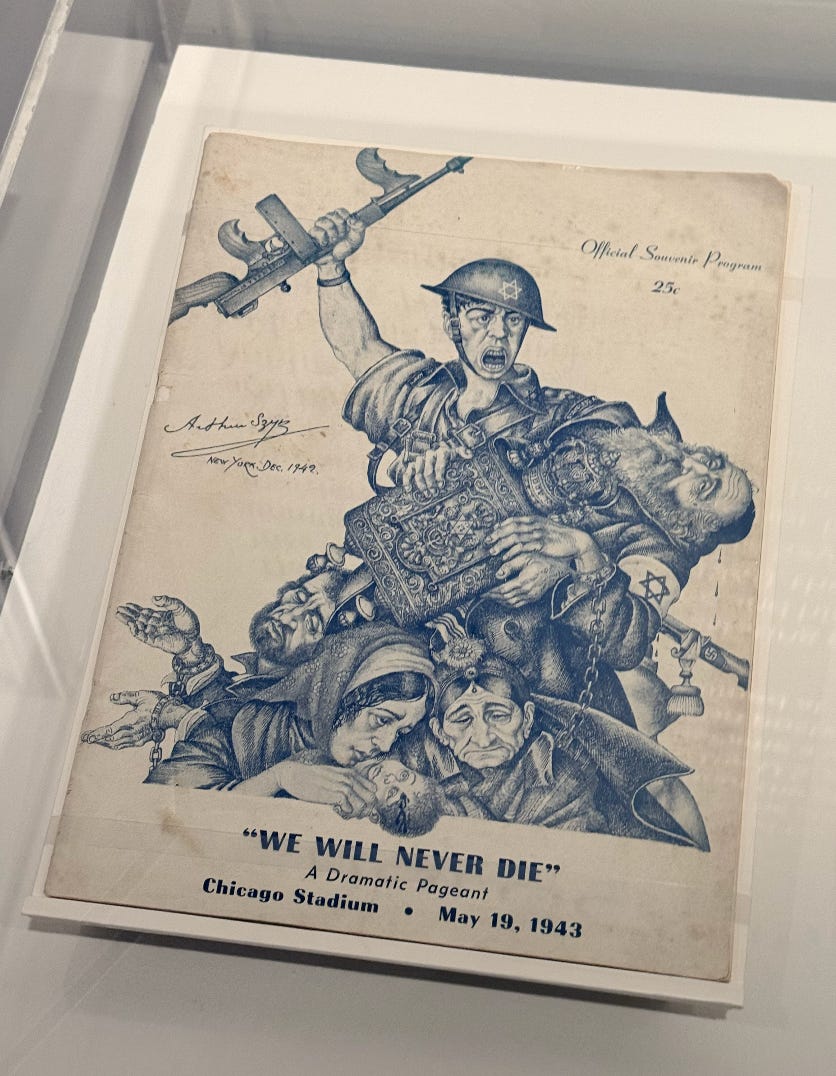
It was impossible to turn away from the reality that his work represented, which also likely made it less comfortable for an American audience both during the war and today. For perhaps it was, and still is, easier to believe that the United States did not rush to aid the Jewish people of Europe because they did not know what was happening. But they did know, and Szyk’s oeuvre leaves no doubts about that; he illustrated the program for a mass memorial called We Will Never Die, which took place at Madison Square Garden in 1942 and was dedicated to the two million murdered Jews of Europe. The memorial was attended by tens of thousands of people and later toured around the country, suggesting that even though Americans knew exactly what was happening in Europe, our government still turned away Jewish people who frantically applied for visas.
The exhibition itself is in a small, windowless, octagon-shaped gallery on the top floor of the museum. The size of the room does a disservice to Szyk’s work; there is an overwhelming amount of images and text to take in, much of it crowded together on the plain white walls. While it is undoubtedly hard to exhibit minutely detailed drawings like Szyk’s, the Museum of Jewish Heritage could have sought inspiration from the exhibitions at the Morgan Library, which does so very well. Even if hanging the show in a larger space was not feasible, the gallery could have benefitted from a couple of extra walls to break up the monotony and create a clearer path for the visitors. Furthermore some additional features like a timeline or a map could have helped to make Szyk’s story more engaging and comprehensible for viewers.
Regardless, the show provides a much-needed platform for Szyk’s work. Szyk was left to the annals of the art world largely due to the technical precision with which he created his masterpieces, and yet that precision became an incredibly important and poetic aspect of his work. For after the war he was able to recreate scenes of a world that had been lost, as evidenced by the vignettes of Jewish holidays he drew in 1948 that recall memories of his childhood and family life. He was also able to create ideals of what a post-Holocaust-Jewish world could look like, depicting Jewish soldiers fighting for the survival of the State of Israel. He thus became both a portal to the past and a seer of the future.
Szyk was unafraid to make his opinions known, stating in 1934, “An artist, and especially a Jewish artist, cannot be neutral in these times. He cannot escape to still lifes, abstractions, and experiments. Art that is purely cerebral is dead.” While this view may have labeled him a pariah in the art world, his works helped encourage millions of Americans to support the plight of the Jewish people and the fight against Fascism. Szyk sacrificed his own legacy to try to help save the lives of others, and there is perhaps no stronger testament to the power of art than that.
Art of Freedom: The Life and Work of Arthur Szyk is on view at the Museum of Jewish Heritage in New York City until July 26, 2026.
—Emily Selter